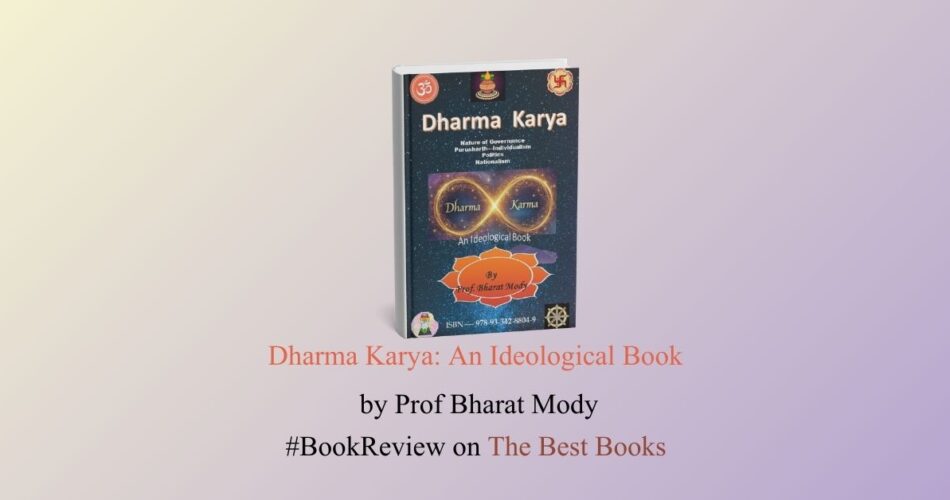
Prof. Bharat M. Mody’s DHARMA KARYA: An Ideological Book represents one of the most ambitious and provocative intellectual undertakings in recent Indian thought. It is not written as a mere academic exercise or a philosophical reflection; it is conceived as a total civilisational document, a work that challenges the assumptions upon which modern India, and indeed modern civilisation, has been built. The author’s aim is not to interpret history or philosophy within existing paradigms but to replace those paradigms altogether with a system grounded in Sanatan Dharma, which he insists is neither religion nor doctrine but the original and enduring way of life. The book thus reads as a combination of manifesto, critique, and philosophical argument, written with a sense of urgency and conviction that immediately sets it apart from the cautious tone of conventional scholarship.
From the very beginning, Prof. Mody declares his dissatisfaction with the present world order. The modern world, as he describes it, is in a state of ideological decay. Its governing systems are confused, its moral codes corrupted, its educational and healthcare institutions colonised by Western thought, and its political foundations detached from philosophy. His premise is that human civilisation has reached a point of exhaustion because it has abandoned the philosophical and moral compass that once bound individuals to reason and righteousness. The consequence of this abandonment is evident, he suggests, in every sphere of life, from politics and economics to culture and morality. It is a world that has lost its soul. Against this backdrop, DHARMA KARYA proposes Sanatan Dharma as the only enduring alternative, an ideology that integrates individual purpose, collective order, and cosmic balance into a unified framework.
The author’s concept of Sanatan Dharma is not confined to theology or ritual. It is understood as a philosophical and scientific worldview that sees existence as interdependent and eternal. He defines it as a culture-rich, artistic, and sustainable civilisation, guided by reason rather than revelation. Unlike religion, which he associates with belief, obedience, and adherence to a single God or sacred text, Sanatan Dharma, in his view, is open-ended and rational. It accommodates multiple paths to truth and treats knowledge as holy rather than forbidden. This distinction is one of the book’s cornerstones. Mody contends that religions such as Christianity and Islam, by insisting upon exclusive authority and submission, have produced systems of faith that inhibit knowledge and enslave the intellect. He cites the myth of the “Original Sin” as emblematic of this worldview, interpreting it as an allegory for the rejection of knowledge and human independence. The notion that knowledge could be sinful, he argues, reveals the anti-intellectual essence of these faiths.
In contrast, Sanatan Dharma celebrates knowledge as a divine pursuit and human reason as an instrument of liberation. It does not compel belief but invites understanding. A follower of Dharma is not a believer in the religious sense but a seeker who learns through experience and reflection. For Mody, this capacity for rational inquiry explains why the Hindu civilisation has survived thousands of years of invasion and oppression while other civilisations, such as Greek, Roman, Mayan, and Communist, have collapsed under the weight of their own contradictions. Survival here is not merely historical endurance but philosophical resilience. Sanatan Dharma, by being flexible and self-correcting, has remained vibrant while others have ossified. This argument allows Mody to position Dharma as the last remaining civilisation, one capable of providing the philosophical basis for a new global order.
The moral vision that underpins the book is equally distinctive. Prof. Mody’s ethics are founded on the principle of Purusharth, the fourfold pursuit of human life: Dharma (righteousness), Artha (prosperity), Kama (pleasure), and Moksha (liberation). These four goals, when rightly balanced, produce a moral order that neither suppresses the individual nor neglects the collective. The individual, in his conception, is not an instrument of society but its moral nucleus. He rejects the idea of self-sacrifice as an ethical ideal, calling instead for enlightened self-interest. A person who lives by Dharma, he argues, contributes to the collective welfare not through altruism but through integrity and self-realisation. He equates this idea with what he terms “ethical individualism.” It is a philosophy that treats self-interest as a virtue rather than a vice, provided that it operates within the moral bounds of Dharma. The notion of sacrifice, celebrated in the altruistic ethics of Christianity and Islam, is criticised as the glorification of dependency and weakness. To deprive the individual of self-interest, he contends, is to rob society of its creative force.
This moral individualism extends into his political and economic philosophy. Prof. Mody views the current Indian democratic structure as an imported system incompatible with Bharat’s civilisational ethos. He describes India’s post-independence governance as a pseudo-democracy, dominated by party politics, high-command culture, and a lack of philosophical direction. He is sharply critical of both Gandhi and Nehru, whom he portrays as leaders unable to grasp the true essence of freedom and sovereignty. Gandhi’s moral influence, he argues, was excessively idealistic and sentimental, while Nehru’s intellectual dependence on Western socialism produced a confused and ineffective governance model. The Constitution, drafted in haste and inspired by colonial jurisprudence, is seen as a legal framework without spiritual or philosophical depth. Mody laments that the courts, in particular judgments, even declared the Preamble to be non-binding, which, to him, symbolises the absence of a philosophical soul in the nation’s foundational document.
His alternative is a system he calls a Political Republic, where governance is not based on party allegiance but on direct public participation and philosophical integrity. He envisions mechanisms such as referendums, public recall, and initiatives that allow citizens to exercise sovereignty directly. This vision, though utopian to some, is consistent with his broader ideal of self-governance. The individual who governs himself by Dharma becomes the model for a nation that governs itself without tyranny. The final expression of this ideal is what he calls Ram Rajya—a state of perfect harmony between ruler and ruled, sustained by mutual trust, virtue, and moral discipline.
In the realm of economics, DHARMA KARYA advocates for Laissez-Faire Capitalism guided by ethical principles. Mody argues that capitalism, when freed from state control and guided by moral reason, aligns naturally with Dharma. It rewards creativity, effort, and productivity while respecting individual liberty. He rejects socialism as an immoral doctrine that penalises success and promotes dependency through redistribution. His critique of socialism is not limited to economics; it extends to morality as well. In his view, socialism breeds mediocrity because it subverts the law of karma by separating action from consequence. True justice, he insists, is not in equality of outcome but in equality of opportunity, where every individual reaps the fruit of his own effort. Wealth creation, therefore, becomes a moral act when pursued through legitimate means and used for one’s own development and the service of society.
Prof. Mody’s reflections on education and healthcare reveal the same pattern of thought. He treats both as integral parts of civilisational development rather than specialised sectors. The Western-inspired Macaulay education system, he argues, has produced generations of dependent minds, trained to serve rather than to think. It has severed Indians from their philosophical and cultural roots, leaving them intellectually colonised. To correct this, he advocates a revival of the Vedic Gurukul system, where education is not confined to academic subjects but extends to character formation and spiritual growth. Knowledge, in this system, is experiential and moral, aimed at producing citizens who act with wisdom and integrity. Similarly, in healthcare, he calls for a synthesis that places Ayurveda at its core. The modern, disease-centred approach must, he argues, give way to a person-centred model grounded in prevention, balance, and natural living. Health is not a social entitlement but a personal responsibility rooted in lifestyle and awareness.
One of the most striking aspects of DHARMA KARYA is its consistent effort to translate ancient philosophical concepts into modern socio-political realities. The author does not treat texts like the Ramayana or the Mahabharata as mythological stories but as moral and political allegories that offer lessons in leadership, ethics, and human conduct. He presents them as evidence of a civilisational continuity that can still inform modern governance and human behaviour. His references to philosophy are not ornamental; they are functional, serving to construct an intellectual bridge between the ancient and the contemporary.
Yet, the book is not without its contentious aspects. Its polemical critique of Christianity and Islam, its rejection of secularism, and its proposal to classify citizens according to religious identity make it a text that will undoubtedly provoke debate. To many readers, these positions may appear exclusionary, but within Mody’s logic, they stem from a conviction that ideological clarity is essential for civilisational survival. He argues that Sanatan Dharma’s openness cannot coexist indefinitely with ideologies that seek to convert or dominate. His call for “cleansing” the political and educational systems of colonial and religious distortions is a metaphor, albeit a strong one, for reclaiming cultural sovereignty.
What ultimately makes DHARMA KARYA compelling is its audacity. It attempts to reimagine the world not through reformist gradualism but through philosophical revolution. It insists that sustainability, freedom, and justice cannot be achieved through material or technological progress alone but must be grounded in ethical and spiritual renewal. Its rejection of imported ideologies, its insistence on individual responsibility, and its vision of an integrated civilisation mark it as a work of ideological clarity and moral conviction.
For readers familiar with India’s intellectual history, the book can be seen as part of a long tradition of reformist thought that includes figures such as Vivekananda, Aurobindo, and Deendayal Upadhyaya, each of whom sought to restore Dharma as the guiding principle of Indian life. Yet, Mody’s tone and approach are uniquely modern, combining philosophical reflection with political pragmatism and a fierce critique of global systems. He does not argue for isolationism or a retreat into tradition but for a confident assertion of Bharat’s civilisational identity as a guiding model for the modern world.
In its totality, DHARMA KARYA is a difficult book to categorise. It is philosophical yet polemical, historical yet visionary, Indian in its essence yet global in its ambition. It demands from its reader both intellectual engagement and moral introspection. Whether one agrees with its prescriptions or not, it is impossible to deny its intellectual seriousness and the urgency of its appeal. Prof. Mody’s work challenges the complacency of both political elites and academic thinkers by asserting that a civilisation’s health depends on its fidelity to its philosophical core. In the final analysis, DHARMA KARYA is less a book than a call to rediscover the moral and intellectual architecture of civilisation itself, a reminder that the survival of Bharat and the sustainability of the world may ultimately rest upon the principles of Sanatan Dharma that it so passionately seeks to restore.
Get a copy of this book from Amazon India now – click here to buy.
Review by Sanjeet Jha for The Best Books