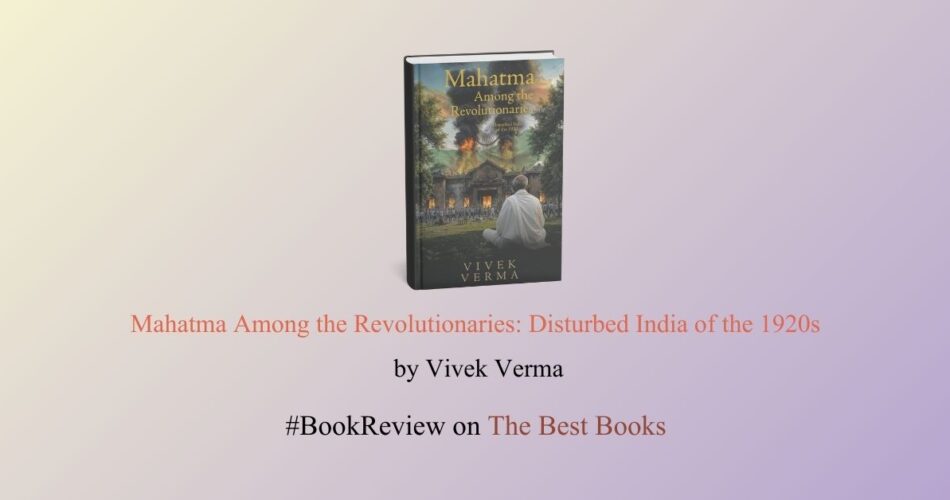
Mahatma Among the Revolutionaries: Disturbed India of the 1920s, a new book by Vivek Verma, has left me surprised, shocked and also very intrigued. Why could not we see history beyond binaries? Why could we not read between the lines of the Indian history of freedom? Why were we not able to understand the narrative of the Indian freedom struggle beyond the standard textbooks that juxtapose the so-called “garam dal” and “naram dal” leaders? Let’s dive into this fantastic non-fiction book! I am sharing my impressions in this detailed book review.
Mahatma Among the Revolutionaries can be read in many ways, but one of its most revealing aspects lies in its exposure of the psychological theatre of empire and resistance. This perspective adds new dimensions to our understanding. Rather than treating Indian nationalism merely as a sequence of events or ideological camps, Vivek Verma reconstructs the emotional climate in which decisions were made, slogans were shouted, bullets were fired, and silences were maintained. This approach produces a reading experience that feels less like a settled historical verdict and more like an encounter with unresolved tensions that still echo in the present.
One of the most arresting aspects of the book is its attention to how colonial power perceived Indians, and how that perception shaped policy as much as prejudice did. The inclusion of the British parody song sung during the First World War — “We don’t want to fight; but, by jingo, if we do, / We won’t go to the front ourselves, but we’ll send the mild Hindoo” — is not a casual anecdote. Verma uses it to underline a fundamental contradiction: the empire relied on Indian bodies to defend it globally while denying Indians political dignity at home. This casual racism, normalised through humour and popular culture, becomes a quiet but persistent engine of resentment. The book makes clear that nationalist anger did not grow solely from spectacular atrocities but from everyday humiliations that accumulated over decades.
Vivek Verma is particularly effective in showing that, when it appeared, violence was not an eruption from nowhere but a response to sustained moral and political deafness. The Hunter Commission testimony of General Dyer is placed not merely as a record of brutality but as an articulation of colonial logic. Dyer’s statement that he wanted “to make a wide impression… throughout the Punjab” reveals a governing philosophy based on fear as pedagogy. In response, the author juxtaposes Winston Churchill’s remark in Parliament that “frightfulness is not a remedy known to the British pharmacopoeia.” The contrast is striking not because Churchill was compassionate, but because even this condemnation failed to translate into structural accountability. The massacre remained a warning, not an aberration. Verma’s treatment here is measured and incisive, resisting melodrama while allowing the moral asymmetry of empire to speak for itself.
What distinguishes this book from many others is how it treats mass politics as a living organism rather than a backdrop. The chant raised against the Simon Commission — “Hindustani hain hum, Hindustan hamara; Mur jao Simon, jahan hai desh tumhara” — is analysed not just as protest but as collective self-definition. Verma suggests that this slogan mattered because it articulated ownership: of land, of destiny, of political voice. It marked a moment when Indians across regions rejected the presumption that their future could be drafted without them. The death of Lala Lajpat Rai soon after, and his warning that violent revolution would be the government’s responsibility, acquires a tragic inevitability in this context. The book does not glorify the chain of revenge that followed, but it insists that it be understood as causally rooted rather than morally mysterious.
The reviewer’s appreciation deepens further when the narrative turns to the HSRA and the assassination of Saunders. The posters declaring, “We are sorry to have killed a man. But this man was a part of cruel, despicable, and unjust system and killing him was a necessity,” are examined not as propaganda but as a moral argument. Verma is careful here: he neither endorses nor dismisses the claim. Instead, he situates it within a political culture where justice had become inaccessible through lawful means. The book’s strength lies in its refusal to collapse this moment into simple condemnation or celebration. It treats revolutionary violence as an ethical claim made under extreme constraint, and invites the reader to grapple with its implications rather than evade them.
Jawaharlal Nehru’s declaration at Lahore that “India is a nation on the march, which no one can thwart” is used by the author to signal a shift in the grammar of politics. This was not merely optimism; it was an attempt to discipline impatience without extinguishing it. Nehru’s confidence is shown to be both inspirational and fragile, standing between the raw anger of revolutionary youth and the cautious incrementalism of constitutional negotiation. The book makes a persuasive case that Purna Swaraj emerged not from consensus but from exhaustion with half-measures.
Gandhi’s role in this landscape is portrayed with notable freshness. Verma does not repeat the familiar image of Gandhi as an abstract moral force. Instead, he foregrounds Gandhi’s tactical awareness and emotional intelligence. When Gandhi writes, “On bended knee, I asked for bread and received a stone instead,” the line is read not as lament but as diagnosis. The refusal of the eleven demands made the futility of negotiation under existing terms clear. The Salt Satyagraha that followed is interpreted as an act of political re-education, aimed at teaching ordinary Indians that defiance could be disciplined, collective, and morally charged.
Perhaps one of the book’s most original insights lies in its treatment of women’s participation during the salt movement. Gandhi’s exhortation that “every woman of India hold onto her lump of illicit salt as she would hold to her fond child” is not read sentimentally. Verma shows how this metaphor transformed domestic instinct into political resolve. Resistance here was intimate, bodily, and emotionally anchored. It challenged colonial authority not through spectacle alone but through persistence in everyday spaces the state struggled to control.
The Chittagong Armoury Raid is approached with similar analytical care. Surya Sen’s belief that the first act of resistance is always “premature, imprudent, unwise and dangerous” is treated as philosophical realism rather than recklessness. Verma situates this mindset within a global revolutionary tradition, suggesting that symbolic defiance often precedes practical success. The raid’s failure, in this telling, does not negate its historical significance; rather, it reveals a generation’s willingness to act without guarantees.
The emotional culmination of the book arrives with Subhas Chandra Bose’s furious rejection of the Gandhi-Irwin Pact. His declaration that “between us and the British government lies an ocean of blood and a mountain of corpses” captures a rupture that Verma refuses to smooth over. Bose’s anger is not dismissed as impatience; it is presented as the voice of those for whom compromise felt like betrayal. By ending on this note of unresolved conflict, the book resists the temptation to portray independence as a harmonious achievement.
Seen as a whole, Mahatma Among the Revolutionaries offers a deeply unsettling but necessary reorientation of India’s freedom narrative. It does not ask the reader to abandon admiration for Gandhi, nor does it demand uncritical reverence for revolutionary martyrs. Instead, it insists that both emerged from the same historical pressure cooker, responding differently to the same denial of dignity. Vivek Verma’s prose is controlled, his scholarship evident, and his moral seriousness unmistakable. The book succeeds not by reconciling contradictions, but by restoring them to the centre of historical understanding. In doing so, it reminds us that freedom was not born of agreement, but of collision and that the noise of that collision still deserves to be heard in full.
You can get a copy of this book from Amazon India – click here.
You can learn more about the author here – Author Vivek Verma
Review by Ashish for The Best Books