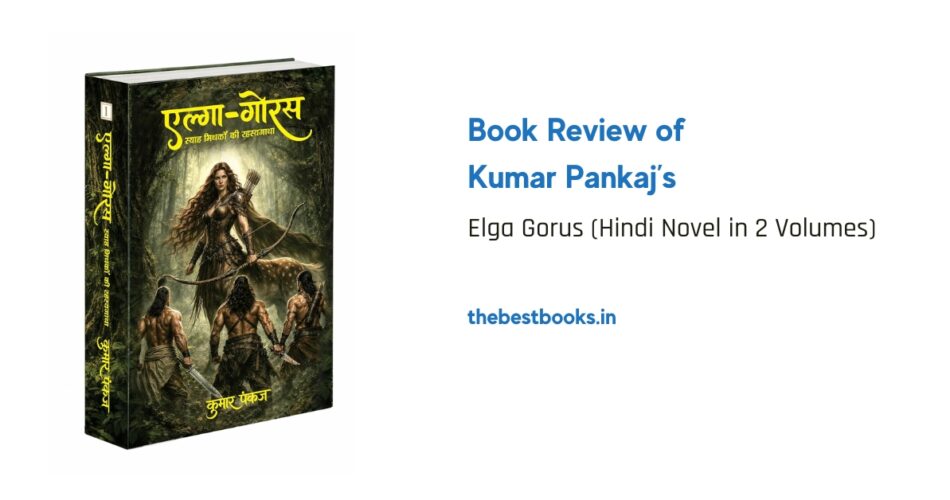
For decades, Hindi literature has enjoyed immense richness in poetry, social realism, historical fiction, philosophical writing, and literary novels. Yet one area that has remained surprisingly underexplored is large-scale fantasy literature. While generations of readers continue to remember the magic of Chandrakanta and its associated world of tilism and mystery, very few contemporary writers have attempted to build similarly ambitious imaginative universes. This is precisely where Kumar Pankaj’s Elga Gorus becomes significant. Spread across two volumes and subtitled a saga of dark myths, the novel represents much more than an entertaining fantasy adventure. It is a bold attempt to revive the spirit of wonder, mystery, and imagination within contemporary Hindi literature while simultaneously making it accessible and emotionally relevant to modern readers. Well, does this ambitious novel stand its ground against the scrutiny? Let’s discuss in this review.
One of the most admirable aspects of Elga Gorus is the way it bridges the gap between fantasy literature and relatable human experience. This is not an easy task. Many fantasy novels succeed in creating magical worlds but fail to establish emotional connections between readers and characters. Others create relatable characters but lack the imaginative scope necessary to produce a truly memorable fantasy experience. Kumar Pankaj manages to bring both elements together. The novel is populated by ancient beings, mysterious creatures, hidden civilisations, forgotten histories, sacred books, and magical realms, yet the emotions that drive the characters remain deeply familiar. Fear, courage, curiosity, loyalty, ambition, sacrifice, hope, and uncertainty are all present throughout the narrative. Readers may never encounter mythical creatures in their own lives, but they immediately recognise the emotional struggles faced by the characters. This combination of wonder and familiarity is one of the novel’s greatest strengths.
The world-building in Elga Gorus deserves particular appreciation because it demonstrates an extraordinary level of imagination. The novel introduces readers to a universe that feels vast, mysterious, and layered with hidden histories. Ancient scripts, sacred texts engraved on wax tablets, forgotten races, strange creatures, dangerous landscapes, and enigmatic powers all contribute to a richly textured fictional world. What makes this world especially effective is that it never feels random. Every location appears to possess its own mythology, every mystery hints at a larger secret, and every revelation opens the door to further questions. Readers are constantly encouraged to explore deeper into the narrative. The experience often resembles wandering through an enormous labyrinth where every turn reveals something unexpected.
The visual quality of Kumar Pankaj’s writing is another reason the novel remains so engaging. Throughout both volumes, the descriptions possess remarkable clarity and vividness. Mysterious caves, ancient settlements, hidden realms, deserts, forests, and strange territories emerge before the reader with almost cinematic force. Many scenes feel as though they were designed for visual adaptation. One can easily imagine portions of the novel transformed into graphic novels, animated series, or fantasy films because of the strength of the imagery. This visual richness is particularly important in fantasy literature because it allows readers to believe in the existence of worlds they have never seen. Kumar Pankaj succeeds in creating that belief.
Equally impressive is the novel’s extensive cast of characters. Fantasy literature often struggles with maintaining reader interest when large numbers of characters are involved. In Elga Gorus, however, the multiplicity of characters becomes one of the story’s major strengths. The novel introduces readers to warriors, wanderers, mystics, strange beings, and enigmatic figures, each contributing something unique to the narrative. What stands out is that these characters rarely feel interchangeable. They possess distinct personalities, motivations, strengths, and weaknesses. Even when readers encounter particularly unusual creatures or mythological beings, those figures are often given enough emotional depth to remain memorable. As a result, the world feels populated by living individuals rather than symbolic placeholders.
The two-volume structure significantly enhances the reading experience. The first volume functions as a gateway into the universe of Elga Gorus. It introduces readers to the major mysteries, characters, and themes while establishing the atmosphere of wonder and uncertainty that defines the series. The second volume then builds upon this foundation with confidence and ambition. The mythology expands, the stakes become higher, and the mysteries grow deeper. Many readers may find the second volume even more satisfying because it benefits from the emotional investment created earlier. The sense of discovery remains intact throughout, but there is also a stronger feeling of narrative momentum. Rather than simply extending the story, the second volume enriches it.
One of the most refreshing aspects of Elga Gorus is its willingness to embrace imagination without apology. Contemporary fiction often feels compelled to justify itself through realism, social commentary, or historical relevance. While these literary approaches remain valuable, there is also something deeply important about stories that encourage readers to imagine beyond the visible world. Fantasy literature has always served this purpose. It allows readers to explore possibilities, confront fears, and encounter unfamiliar perspectives through symbolic narratives. Kumar Pankaj understands this tradition well. His novel invites readers to embrace mystery, curiosity, and wonder. In doing so, it reminds us that imagination itself possesses literary value.
This point becomes particularly important when considering younger readers. One of the most significant contributions of Elga Gorus may be its potential to inspire a new generation of Hindi readers. Today, many young readers interested in fantasy turn almost exclusively toward English-language literature. Global franchises have shaped their expectations regarding fantasy storytelling, world-building, and adventure narratives. Hindi literature has often struggled to provide equivalent alternatives within the fantasy genre. Kumar Pankaj’s work addresses this gap directly. By creating a large-scale fantasy universe rooted in Hindi storytelling traditions while maintaining the narrative energy expected by contemporary audiences, he offers younger readers something valuable: a reason to engage with Hindi literature on its own terms.
This achievement should not be underestimated. Literature survives not only through critical acclaim but through its ability to attract new readers. A teenager who discovers the pleasures of reading through Elga Gorus may eventually develop a lifelong relationship with Hindi literature. In this sense, Kumar Pankaj’s contribution extends beyond the novel itself. He is helping to expand the possibilities of what younger readers expect from Hindi fiction. He demonstrates that Hindi can accommodate epic fantasy, complex world-building, suspenseful narratives, and immersive mythology without sacrificing literary quality.
The novel also contributes to the ongoing evolution of Hindi fantasy literature. For many years, fantasy has occupied a relatively marginal position within mainstream Hindi literary discussions. Works belonging to the genre have often been viewed as secondary to more socially or politically oriented literature. Elga Gorus challenges this assumption. It shows that fantasy can be ambitious, sophisticated, and culturally meaningful. By drawing inspiration from the legacy of tilism while simultaneously introducing modern storytelling techniques, Kumar Pankaj creates a bridge between literary tradition and contemporary genre fiction. This synthesis may encourage other writers to experiment with speculative storytelling, mythology, and fantasy in new ways.
Of course, the novel’s scale can occasionally present challenges. The extensive cast of characters, complex mythology, and numerous narrative threads require concentration from readers. Some may initially feel overwhelmed by the abundance of information, particularly during the early stages of the story. The world-building is dense, and the narrative often prioritises atmosphere and mystery over immediate explanation. However, these challenges emerge largely from the novel’s ambition rather than from any fundamental weakness. Readers willing to invest time and attention are rewarded with a richly immersive experience.
Ultimately, Elga Gorus stands as one of the more ambitious fantasy projects to emerge in contemporary Hindi literature. It combines mystery, adventure, mythology, imagination, and emotional depth in a manner that feels both entertaining and significant. Kumar Pankaj deserves appreciation not only for the scale of his creative vision but also for his determination to offer Hindi readers, particularly younger ones, a fantasy universe they can proudly call their own. The novel succeeds because it understands that fantasy is not merely about magical creatures or hidden realms. At its best, fantasy allows readers to rediscover wonder, curiosity, courage, and possibility. Across two expansive volumes, Elga Gorus accomplishes precisely that. It invites readers into a vividly imagined world and leaves them with the feeling that imagination still has the power to surprise, inspire, and transform.
Get a copy of the novel from Amazon – click here to buy now.
Review by Chitra M for The Best Books