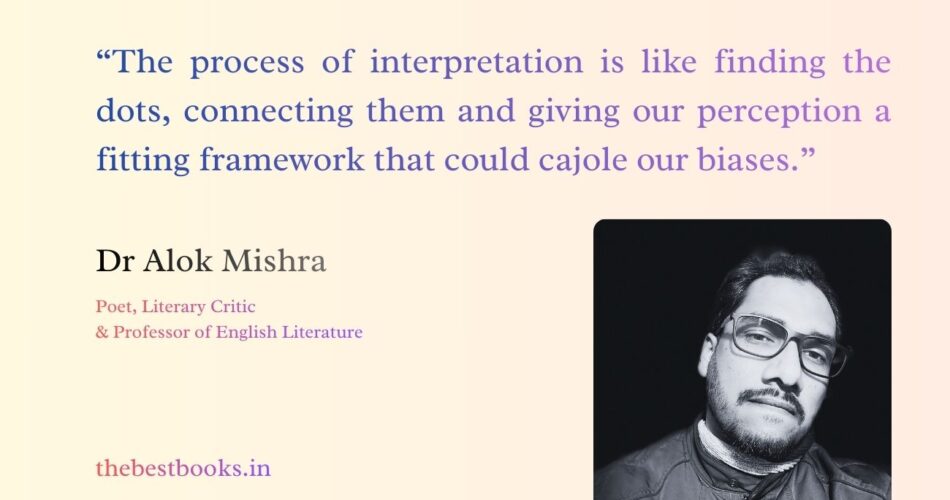
The discourse on literary criticism in contemporary times frequently oscillates between academic rigidity and readerly freedom. In this fluctuating intellectual landscape, the reflections of Dr Alok Mishra offer a distinctive and thoughtful perspective on reading, interpretation, and the layered nature of literature. His recent essay on reading and interpretation presents a philosophical meditation on how literature functions not merely as a body of written works but as an evolving field of negotiation among author, reader, and text. Examining his ideas through a scholarly lens reveals their relevance to present-day literary criticism and their alignment with broader theoretical traditions.
Dr Alok Mishra begins with a simple yet intellectually charged assertion that “reading, rather, is an act that involves conscious and subconscious faculties coming together and decrypting various layers of the literary text.” This statement encapsulates his central premise: reading is not a passive act but an interpretive engagement involving both intellect and intuition. In positioning reading as a process of decryption, he aligns himself with traditions of close reading and hermeneutic inquiry that view literature as layered and multi-dimensional. The reader, in this formulation, is neither subordinate to the author nor detached from the text. Instead, the reader becomes a co-creator of meaning.
This understanding resonates strongly with reader-response criticism, which emphasises the reader’s role in actualising meaning. Reader-response theory holds that literature attains “real existence” only when interpreted by readers, each bringing their own cultural and psychological frameworks into the reading process. Dr Mishra’s reflections echo this principle while adding a nuanced philosophical dimension. For him, interpretation is not merely an intellectual exercise but a negotiation between conscious and subconscious faculties. The reader interprets not only the text but also the accumulated knowledge and biases that shape perception.
One of the most compelling insights in his essay is the observation that “when we interpret literature, we don’t only interpret a work by an author. We also interpret our burden of knowledge at the same time.” This formulation foregrounds the reflexive nature of reading. Interpretation becomes an act of self-examination. Every attempt to understand a text simultaneously reveals the interpretive frameworks that the reader brings to it. In contemporary literary discourse, this aligns with post-structuralist notions of the instability of meaning and the impossibility of objective interpretation. Yet Dr Mishra’s tone remains less theoretical and more experiential. He does not merely invoke theory but translates its implications into the lived experience of reading.
His comparison of interpretation to “finding the dots, connecting them and giving our perception a fitting framework that could cajole our biases” is particularly revealing. The metaphor suggests that interpretation is both constructive and corrective. Readers assemble fragments of meaning, yet they must remain vigilant against the temptation to confirm pre-existing biases. In this respect, Dr Mishra’s ideas converge with the ethical concerns of modern criticism, which emphasise the need for intellectual self-awareness. The critic must recognise personal predispositions while striving for interpretive fairness.
This concern with bias is central to his broader philosophy of criticism. He acknowledges that complete objectivity may be unattainable but insists that serious critics must resist being “intellectually seduced by their biases.” Such resistance demands discipline and humility. It also requires what classical Indian aesthetics termed sahridayata, the capacity to respond to literature with sensitivity and openness. Dr Mishra’s invocation of ancient Hindu ascetics who remain focused on spiritual purpose while living in the material world serves as a metaphor for the critic’s ideal state. The critic must inhabit biases without surrendering to them. In totality, he writes:
“When we interpret literature, we don’t only interpret a work by an author. We also interpret our burden of knowledge at the same time! The process of interpretation is like finding the dots, connecting them and giving our perception a fitting framework that could cajole our biases. However, some accomplished critics always resist being intellectually seduced by their biases, as the ancient Hindu sadhus who could concentrate on the purposes of their souls while living in their mortal bodies on this illusory planet!”
Dr Alok Mishra
Equally significant is his exploration of whether literature can be enjoyed without critical interpretation. He poses a question that has long occupied literary theorists: can reading remain purely aesthetic, free from analytical engagement? He acknowledges the linguistic argument that readers inevitably engage with texts through prior knowledge and biases. This recognition challenges the romantic notion of detached aesthetic enjoyment. For Dr Mishra, reading is always interpretive, whether consciously or subconsciously. Even casual readers negotiate meaning, albeit informally. Thus, criticism becomes an extension of ordinary reading rather than an elitist enterprise.
At the same time, he does not dismiss the possibility of aesthetic pleasure. Instead, he suggests that enjoyment and interpretation coexist. The reader may experience what he calls “detached ecstasy” while simultaneously engaging with the text’s implicit meanings. This balanced view distinguishes his approach from more rigid theoretical frameworks that either prioritise aesthetic experience or emphasise ideological critique. For Dr Mishra, literature accommodates both. It offers pleasure and provokes reflection. The reader navigates between these dimensions, often unconsciously.
His insistence that reading involves “multiple layers of negotiation between the reader and the author” situates literature within a dialogic framework. Meaning emerges through interaction rather than transmission. Authorial intention, readerly perception, and textual structure interact dynamically, producing interpretations that vary across contexts. This perspective aligns with Mikhail Bakhtin’s concept of dialogism, which views texts as sites of interaction between multiple voices and perspectives. Although Dr Mishra does not explicitly reference Bakhtin, his formulation reflects a similar understanding of literary communication.
In contemporary literary culture, this emphasis on negotiation is particularly relevant. Readers today encounter texts within highly diverse cultural and ideological contexts. Globalisation, digital media, and academic pluralism have expanded interpretive possibilities. A single literary work may generate radically different readings across geographical and cultural boundaries. Dr Mishra’s framework accommodates this diversity without collapsing into relativism. He recognises that biases shape interpretation but insists on disciplined engagement with textual layers.
Another dimension of his thought concerns the limits of interpretive possibility. He observes that fully grasping the depths of certain authors may never be “possible in the truest sense.” By invoking figures such as Kafka, Beckett, Russell, and Sri Aurobindo, he highlights the complexity of literary texts that resist definitive understanding. This acknowledgement of interpretive limitation introduces a necessary humility into criticism. The critic’s task is not to exhaust meaning but to explore it responsibly. Such humility contrasts sharply with the tendency in some academic circles to produce authoritative readings that claim finality.
Dr Mishra’s reflections also invite comparison with the practice of close reading. Close reading emphasises careful attention to textual detail, syntax, and structure as the basis for interpretation. His insistence on decrypting layers of meaning resonates with this methodology. However, he extends the concept beyond textual analysis to include psychological and cultural dimensions. For him, close reading is not merely a technical exercise but an engagement with the reader’s own interpretive frameworks.
Furthermore, his approach intersects with psychoanalytic criticism, which views literature as intertwined with the psyche. Psychoanalytic critics explore how unconscious desires and anxieties shape both literary creation and interpretation. Dr Mishra’s emphasis on subconscious faculties and internal negotiations reflects a similar awareness of the psychological dimensions of reading. Yet he avoids reducing literature to psychological symptomatology. Instead, he integrates psychological insight with aesthetic appreciation and ethical responsibility.
The contemporary relevance of Dr Mishra’s ideas becomes particularly evident when we consider the current state of literary criticism. Academic criticism often prioritises theoretical sophistication over readerly engagement. Jargon-laden analyses risk alienating general readers, reinforcing the perception that criticism is an esoteric discipline. Dr Mishra’s insistence on accessible yet thoughtful interpretation challenges this trend. He envisions criticism as an inclusive practice that bridges scholarly inquiry and readerly experience.
His broader reflections on criticism reinforce this vision. He has described meaningful criticism as an endeavour that “directly serves the collective consciousness of humanity.” This formulation elevates criticism from a purely academic exercise to a cultural responsibility. Critics, in this view, facilitate dialogue between literature and society. They illuminate layers of meaning that might otherwise remain unnoticed, thereby enriching collective understanding. Such a perspective recalls Matthew Arnold’s notion of criticism as a pursuit of the best that has been thought and said. Yet Dr Mishra extends this mission by emphasising accessibility and readerly participation.
In juxtaposition with other contemporary critics, his stance appears refreshingly balanced. While some critics advocate purely theoretical approaches and others champion readerly freedom without discipline, Dr Mishra seeks a middle path. He acknowledges the inevitability of bias yet urges critics to resist intellectual complacency. He values aesthetic pleasure while advocating rigorous interpretation. He recognises the multiplicity of meanings without abandoning the pursuit of coherence. This integrative approach distinguishes his contribution to contemporary literary thought.
Moreover, his reflections carry pedagogical implications. In an era where students often encounter literature through examination-oriented frameworks, his emphasis on layered reading encourages deeper engagement. Students are invited to move beyond summarisation and thematic identification toward interpretive exploration. Such an approach fosters intellectual curiosity and critical independence. It transforms literature from an academic requirement into an ongoing dialogue with human experience.
In conclusion, Dr Alok Mishra’s reflections on reading and criticism offer a compelling framework for understanding literature in the contemporary world. By emphasising layered interpretation, readerly negotiation, and ethical awareness, he redefines criticism as a dynamic and inclusive practice. His insistence that reading engages both conscious and subconscious faculties underscores the complexity of literary engagement. At a time when literary criticism risks becoming either overly technical or overly casual, his balanced vision provides a valuable corrective. It reminds us that literature is not merely to be consumed or dissected but to be experienced, questioned, and continually reinterpreted. In doing so, criticism becomes not an academic obligation but an intellectual and cultural necessity, sustaining literature’s relevance in an ever-evolving world.
Chandan for The Best Books
Article based on Dr Alok Mishra’s ideas on criticism and literature, recently shared on his official website – Dr Alok Mishra
Dr Alok Mishra is a literary critic, poet and a professor of English Literature at Nava Nalanda Mahavihara