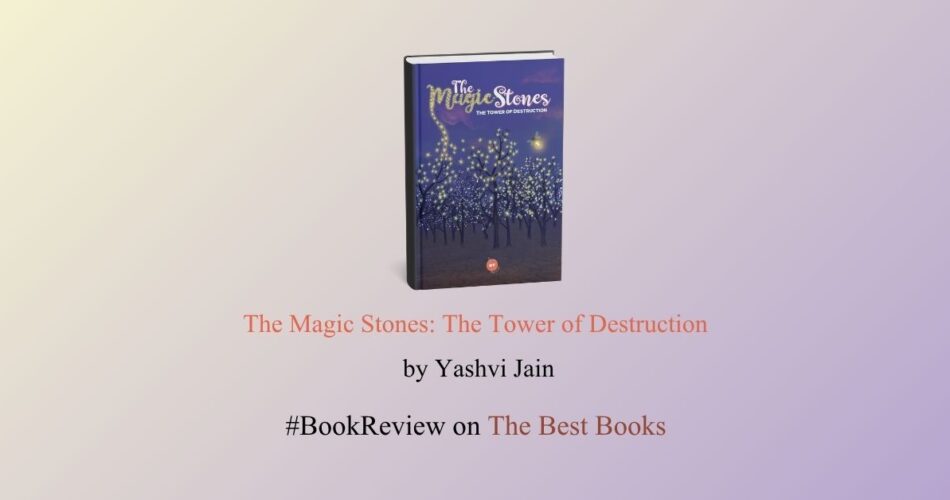
Yashvi Jain’s The Magic Stones: The Tower of Destruction is an ambitious second instalment in a fantasy-adventure series that seeks to combine supernatural powers, friendship, suspense and moral questions within a fictional world of its own making. Published in 2023, the book continues the adventures of Flora Bennett and Rosy Kelly, taking them beyond the mysteries introduced in the first volume, The Magic Stones: Dark Dreams. The scale of the adventure expands considerably as the protagonists encounter Astrolen, a city caught in the grip of the sinister Dark Dreams organisation, led by the formidable Dolores. What begins as a struggle for personal survival gradually becomes a larger attempt to protect a population threatened by an oppressive power. The magic stones, which previously served as gateways into unfamiliar places, acquire a deeper significance, while the girls discover that their abilities may be more complex than they had understood.
The premise of the novel makes one thing very clear. Yashvi Jain, the young author, clearly intends to build something larger than a succession of disconnected adventures. She is attempting to create a fantasy universe in which magical objects, extraordinary powers, political conflict and personal responsibility contribute to a continuing narrative. The book’s principal strength lies in this imaginative ambition. Its limitations, meanwhile, emerge from the challenge of translating a wealth of ideas into a consistently controlled narrative. The result is an energetic work of young adult and children’s fantasy that offers considerable imaginative appeal, even as its prose, pacing and character development reveal room for further refinement.
One of the most encouraging aspects of The Tower of Destruction is the manner in which it enlarges the world established in the first book. Rather than simply reproducing the structure of an adventure centred on a mystery, Jain places her protagonists within a more elaborate conflict. Astrolen introduces a distinctive setting, populated by characters with unusual abilities and governed by rules that Flora and Rosy must gradually understand. The visual imagination is particularly evident in the description of the city, its unusual architecture and its relationship with the natural elements. The image of buildings made of glass, explained as a symbol of truth and openness, is a useful example of Jain’s willingness to give a fictional setting an idea as well as an appearance. The landscape is not merely a backdrop against which the characters perform their adventures; it can also suggest the values by which its inhabitants understand themselves. The floating structures, unusual skies, portals and magical objects provide the story with a sense of wonder that should appeal to readers who enjoy fantasy worlds constructed around visual spectacle. Jain also understands that a sequel needs to broaden the reader’s understanding of the fictional universe. The introduction of new places and characters makes the series feel larger, while the discovery of additional powers creates possibilities for future conflicts. Yet world-building involves more than introducing new wonders. Every new location and magical rule places a demand on the reader’s attention. The more elaborate a fictional universe becomes, the more carefully the author must organise its details. Jain’s imagination is expansive, but the narrative would become more persuasive if the relationships between its various elements were sometimes explained with greater economy and precision.
The central conflict gives the book a stronger sense of purpose than a simple adventure built around magical discovery. Dolores and the Dark Dreams organisation represent a threat that extends beyond the immediate safety of Flora and Rosy. The Tower of Destruction is associated with imprisonment, forced labour and a system in which the suffering of some becomes a condition of survival for others. This development introduces a darker dimension into the series. The protagonists are no longer merely trying to understand unfamiliar powers or escape dangerous situations; they must also decide how far they are willing to go to help people who have been placed in intolerable circumstances. The notion that an entire population can be held hostage by a single oppressive force raises questions about power, coercion and responsibility. Yashvi deserves credit for recognising that fantasy can accommodate such concerns without losing its appeal to younger readers. The extraordinary setting allows her to examine recognisable human problems from a distance, making difficult circumstances accessible through the experiences of young protagonists. The conflict also raises the stakes of the narrative. Flora and Rosy are faced with situations in which their decisions may have consequences for people they do not know personally. This is a meaningful development in the characters’ adventures because it asks them to move beyond self-preservation. However, the larger moral stakes also create an obligation for the author. Oppression, forced labour and the threat of mass suffering require a degree of narrative seriousness. At certain points, the story’s playful voice sits uneasily beside the severity of the circumstances. Humour is not inherently inappropriate in a dangerous situation, but its placement needs careful judgement if the reader is to feel the full weight of what is at risk.
Flora remains the principal centre of the narrative, and the first-person perspective helps maintain a close connection between the reader and her experiences. Her voice is spontaneous, inquisitive and frequently humorous. She reacts to danger with a mixture of fear, determination and irreverence, which gives the story much of its youthful character. Rosy, meanwhile, functions as both companion and counterweight. Their friendship is one of the more accessible elements of the book because the girls do not always respond to events in the same way. Their conversations provide moments of levity, while their cooperation becomes increasingly important as they attempt to understand their powers and confront the Dark Dreams. The familiar bond between the protagonists also gives younger readers an emotional point of entry into the fantasy. However, the characterisation does not always develop at the same pace as the plot. The story introduces new abilities, new dangers and new revelations rapidly, but the emotional consequences of these developments sometimes receive less attention than the events themselves. Flora’s discoveries could be explored more deeply through hesitation, uncertainty and a gradual change in her understanding of herself. Rosy, too, could benefit from a more independent emotional and psychological trajectory, rather than functioning primarily as Flora’s companion and partner in action. The friendship is convincing as a foundation, but its literary potential would be greater if the characters’ disagreements, fears and individual priorities were explored with more consistency. The book provides its protagonists with many things to do; it could devote more space to showing how those experiences change them.
The development of Flora’s powers is among the more interesting narrative devices in the book. Her abilities are not presented simply as convenient instruments that allow her to overcome every obstacle. She must learn what she can do, understand the limits of her mental energy and consider the risks associated with using her powers. The idea that extraordinary ability comes with physical or mental costs gives the fantasy a useful internal logic. It also creates opportunities for suspense, since the protagonists cannot always assume that their powers will provide an effortless solution. The discovery that different characters may possess different kinds of abilities further expands the possibilities of the series. The connection between particular physical traits and elemental powers, for instance, suggests that Jain is attempting to establish a system rather than introducing magic without any discernible pattern. This is an important step in the development of a continuing fantasy world. Nevertheless, the rules of such a system need to remain consistent and sufficiently clear. When powers appear or develop at moments of immediate danger, readers may accept the surprise, but they also need to understand how the discovery relates to what they have already been told. If the rules remain too flexible, the suspense can weaken because the reader cannot judge what the characters are capable of doing or what obstacles genuinely threaten them. Jain’s ideas are imaginative, and the evolving powers can sustain curiosity, but a more deliberate presentation of their limits and consequences would make the magical system more convincing.
To talk about Yashvi’s prose, it is direct, conversational and energetic. These are the qualities that suit a story told through a young protagonist. Flora’s observations frequently introduce humour into tense situations, and the exchanges between her and Rosy help prevent the narrative from becoming relentlessly serious. The author is also comfortable with visual description. The unfamiliar city, the portals, the elemental disturbances and the Tower of Destruction are presented through images of colour, movement and physical danger. These passages reveal an instinct for scenes that readers can readily imagine. The narrative is rarely short of activity, and the succession of discoveries gives the book a strong sense of forward motion. However, this energy sometimes comes at the expense of stylistic control. The prose can become crowded with actions, explanations, reactions and dialogue, all competing for attention within a short space. Some emotional responses are repeated when the situation has already communicated the character’s fear or confusion. Elsewhere, an explanation is supplied when a reader could reasonably be trusted to infer the point from the preceding action. These habits reduce the impact of scenes that might otherwise be more effective. A stricter editorial process could have improved the book by tightening sentences, removing redundant observations and giving significant moments more room to develop. This is not an argument for making the prose elaborate or difficult. On the contrary, straightforward language is a strength when it is used precisely. The aim should be to preserve the freshness of Flora’s voice while ensuring that every sentence contributes to character, atmosphere, action or meaning.
The dialogue illustrates both the appeal and the limitations of the young author’s approach. The characters speak in an informal register, and their jokes make them accessible to young readers. Flora’s tendency to respond sarcastically to extraordinary or frightening circumstances creates a recognisable comic pattern. At its best, this humour makes the characters feel like young people trying to retain some control over situations that have become overwhelming. The use of a private code word between Flora and Rosy, for example, gives their friendship a practical dimension while reinforcing the sense that they have developed habits and understandings of their own. Yet the comic voice can sometimes become too insistent. When a character responds to danger with a joke, the effect depends on timing and contrast. If every tense episode is quickly interrupted by a humorous remark, the reader may have insufficient time to register the seriousness of the threat. Similarly, a villain becomes less convincing if his menace is repeatedly undercut by theatrical behaviour without a corresponding sense of intelligence, motive or psychological depth. Dolores serves the plot as a recognisable antagonist, but the conflict would gain complexity if his motivations and methods were developed beyond the immediate presentation of cruelty and domination. The author’s interest in questioning simple divisions between good and evil suggests that she has more ambitious possibilities in mind. A more layered antagonist, whose reasoning could be understood without being endorsed, would bring that ambition closer to realisation.
The book’s moral dimension is, in fact, one of its most promising features. The predicament of the prisoners in the Tower of Destruction raises a question that extends beyond the immediate fantasy: can a decision be considered free when every available option involves suffering? Flora reflects on the apparent choice between risking death to protect others and remaining alive under oppressive conditions. This is a more substantial question than the familiar demand that a hero simply defeat a villain. It introduces the possibility that moral decisions may involve competing obligations rather than an uncomplicated distinction between right and wrong. Jain should be encouraged to pursue this line of thought. Children’s literature need not avoid difficult questions, provided that they emerge naturally from the story and are handled with sensitivity to the intended readership. At present, however, the moral reflection is not always fully integrated into the character development. The narrative occasionally moves quickly from a serious dilemma to the next practical challenge, leaving limited space for the implications of the question to unfold. A more patient treatment could allow Flora and Rosy to disagree, reconsider their assumptions or recognise that a seemingly obvious solution may have consequences they did not anticipate. Such moments would strengthen the characters as well as the book’s philosophical dimension. The aim should not be to turn the novel into a moral lesson, but to allow the ethical questions it raises to shape the decisions, relationships and consequences that follow.
Pacing is another area in which the novel’s ambition creates difficulties. The narrative moves through unfamiliar settings, confrontations, revelations and magical developments at a considerable speed. This momentum can be engaging, particularly for readers who enjoy continuous action, and the sequence of new discoveries helps sustain curiosity. Yet speed alone does not guarantee effective pacing. Some events need time to register, especially when they alter the protagonists’ understanding of the world or expose them to serious danger. The book occasionally moves forward before the emotional or logical consequences of an event have been sufficiently absorbed. There are also moments when a new revelation appears to arrive primarily to increase the scale of the adventure. A more selective approach would allow the most important developments to carry greater weight. The same applies to exposition. Readers need enough information to understand the rules of Astrolen and the conflict surrounding the magic stones, but explanations are most effective when they are distributed through meaningful action and dialogue rather than accumulated in ways that interrupt the story. The book’s twelve-chapter structure provides a clear framework, but the larger question is how effectively each chapter contributes to the developing conflict. Greater attention to transitions, causal connections and the balance between action and reflection would make the narrative more cohesive without reducing its imaginative scope.
Despite these limitations, The Magic Stones: The Tower of Destruction demonstrates an encouraging willingness to take creative risks. It enlarges the fictional universe of the first book, gives the protagonists new challenges and introduces a conflict with consequences beyond their immediate circle. Its fantasy elements are accessible, its central friendship offers emotional continuity, and its conversational style is likely to appeal to readers who prefer lively narration to elaborate prose. And that is what the author has targeted – to be honest to her attempt. More importantly, the book shows signs of an author thinking beyond the immediate demands of an adventure story. The magical system, the oppressive structure represented by the Tower of Destruction and the questions surrounding choice and responsibility all offer possibilities for deeper development. The challenge for the author is to ensure that the elements of her imagination support one another rather than compete for space. More economical prose, stronger character development, clearer rules for the use of powers and more deliberate pacing would enable the story’s ideas to register with greater force. The book should therefore be assessed neither as a fully realised achievement nor as a mere exercise in youthful invention. It is a developing work with identifiable strengths and equally identifiable areas for improvement. The Tower of Destruction succeeds most convincingly when it combines imaginative spectacle with genuine questions about power, friendship and moral responsibility. It is less successful when the speed of invention overwhelms the discipline of storytelling. For young readers who enjoy magical adventures, the novel offers an engaging journey into an expanding fantasy world. For Jain as a writer, it represents a further step in learning that imagination creates the possibilities of fiction, while craft gives those possibilities coherence, depth and lasting effect.
Get a copy from Amazon India – click here.
Review by Abhinandan for The Best Books